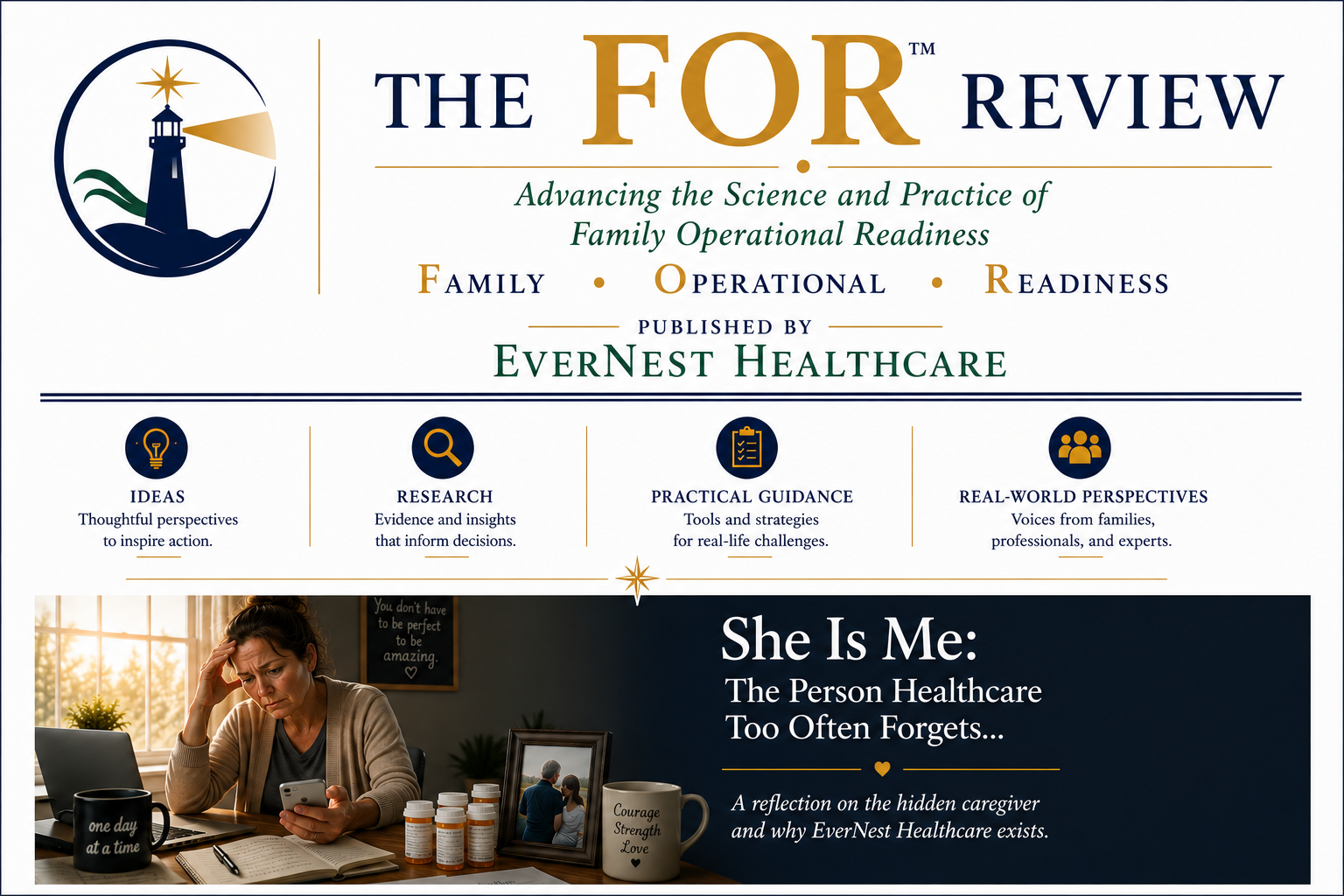
There comes a moment in almost every family when life changes without permission.
It isn’t planned. It isn’t convenient. It arrives with a phone call in the middle of the night, a diagnosis that no one expected, a fall, a stroke, an accident, or simply the slow realization that someone we love can no longer manage alone.
And almost without thinking, one person steps forward.
Usually, it’s a wife.
A daughter.
A sister.
Sometimes a husband or a son.
Someone quietly assumes responsibility for holding everything together.
She begins making phone calls.
Learning medical language she has never heard before.
Managing medications.
Talking with doctors.
Negotiating insurance.
Researching rehabilitation centers.
Trying to understand Medicare.
Trying to understand Medicaid.
Trying to protect the family’s finances.
Trying to reassure frightened children.
Trying not to fall apart herself.
She didn’t apply for this job.
No one trained her for it.
Yet overnight she becomes the project manager for the most important mission of her life.
For years, healthcare has focused almost entirely on the patient.
The patient deserves that attention.
But somewhere along the way we overlooked someone equally important.
The family.
More specifically, the person carrying the weight of the family.
That person often becomes exhausted, isolated, overwhelmed, and afraid—not because she lacks strength, but because the healthcare system asks ordinary people to navigate extraordinary complexity.
I’ve watched this happen for years.
I’ve seen brilliant professionals suddenly unable to understand discharge plans.
I’ve seen successful business executives reduced to tears trying to decide whether their spouse should return home or enter rehabilitation.
I’ve watched adult children struggle to explain complicated medical decisions to aging parents.
These are intelligent, capable people.
They simply found themselves in unfamiliar territory.
And that realization led to an important question.
What if families had a trusted guide?
Not another insurance company.
Not another healthcare provider.
Not another government agency.
Simply someone who understands the journey and helps families make sense of it.
That question became EverNest Healthcare—a company built on the belief that families deserve practical guidance, thoughtful systems and compassionate support during life’s most challenging medical journeys.
EverNest exists because healthcare is about more than medicine.
It’s about people.
It’s about families trying to make the best decisions they can with imperfect information and overwhelming responsibility.
It’s about helping families regain clarity when everything feels uncertain.
But there is another reason EverNest exists.
One that is even more personal.
When most of us read a story about a caregiver, we imagine someone else.
Someone older.
Someone in another family.
Someone whose life is different from ours.
Yet if life teaches us anything, it is this:
Eventually…
She is me.
Because one day we may become the caregiver.
Because one day we may become the patient.
One day we may be the adult child making impossible decisions.
Or perhaps we will be the husband hoping someone knows what to do.
The roles may change.
The names will change.
The story remains remarkably similar.
That is why EverNest Healthcare is not simply a business.
It is a belief.
A belief that families deserve guidance before they become overwhelmed.
A belief that no one should have to navigate life’s most difficult medical moments alone.
And a belief that caring for the caregiver is every bit as important as caring for the patient.
Because when we finally recognize ourselves in the struggles of another family…
We understand something profoundly human.
She is me.
And perhaps, one day…
I will need EverNest Healthcare, too.
Because sooner or later…She is all of us.
About the Author
Kevin J. Cronin is the Founder and Chief Care Navigator of EverNest Healthcare, LLC. Drawing on decades of experience in healthcare, law, business, and rehabilitation, he helps families navigate the operational, emotional, and practical challenges that follow life-changing medical events.